Thursday, June 24, 2010

T-38 Talon - Replacement Finally On The Horizon?


The T-38 has been the USAF's advanced pilot training aircraft since the late '50s. Generations of military pilots have trained in these aircraft. My father, who left the USAF in 1965, learned the figher pilot trade in and later instructed in the T-38.

Most of the 450 or so T-38s remaining in service have just gone through a major update/upgrade, and are now referred to as T-38C. T-38s were manufactured by Northrup from 1959 to 1970. The majority of those still flying were built in 1966, 67, and 68, making the average age of a front line T-38 about 45 years old.


T-38A 68-8139, 7FS 49FW, based and photographed at Holloman AFB. These black jets were used for pilot proficiency and chase plane duties when the 49th was equipped with the F-117A Stealth Fighter.

The T-38C update will keep these aircraft in the air for another decade, if necessary.

The USAF has started the replacement process, finally. In a few months, a contest will be announced for designs and bids to produce the esimated 350 training aircraft deemed necessary to replace the T-38. The winning aircraft could garner as many as 1000 ordered, depending upon foreign customers and possible variations of the basic aircraft (such as a light strike platform).

The competitors appear to be:

Northrup - which is anticipated to offer a further upgrade/life extension program for the existing T-38 airframes.

Korean Air Industries/Lockheed-Martin - this partnership produced the Korean produced T-50 trainer, currently only in use by the South Korean Air Force.

Alenia Aermacchi - expected to offer a derivative of their M-346 trainer, currently in use by the Italian Air Force and others as both a trainer and light strike aircraft.

BAE Systems - which will offer a version of their Hawk training/light strike aircraft, used in the UK, US (Navy), and multiple Air Forces around the world.

Boeing - which is being very quiet about what it will offer, but is thought to be a new design purpose built for the application.

It is expected that some of these companies may team up to push an offering, with Alenia (Italy) and BAE (UK) seeking a US partner, either Northrup or Boeing. A cooperative effort would be stronger in many aspects.

Northrup has experience, in that they are the designers. makers, and maintainers of the current T-38 fleet. The last complete aircraft they produced, however, was the B-2 - very different technology and requirements, and production wrapped up over 15 years ago.

Alenia has worldwide experience with their MB platform, but very limited US experience - and that experience has been with the very limited use of the C-27 medium transport aircraft by the USAF. They would have to be considered an outsider.

BAE has a strong hand. The Hawk platform has dozens of customers worldwide, the most important of which (for this situation) the US Navy, which operates close to 300 of them. These aircraft, called T-45, were built in the US, and are highly modified examples of the main design. The mods were necessary to make the aircraft suitable for use on aircraft carriers. If BAE is chosen, the aircraft would likely be built through their partnership with Boeing, the same way the T-45 was produced.

Boeing, by itself, would have a hard time pushing a brand new aircraft to fill the need. With the spiralling costs and mismanagement seen in the F-22 and F-35 programs, Congress is not going to be in the mood to purchase billions of dollars worth of new, unproven designs when existing aircraft can be used with minimal program risk.

KAI/L-M's big advantage is that Lockheed is the manufacturer of the only two fighter aircraft that will be left in the inventory by the time the new trainer reaches operational capability - the F-22 and the F-35. L-M's familiarity with those aircraft would allow them to claim the knowledge necessary to build a trainer that would lead into the -22 and -35 seamlessly. There is a big drawback in that approach; since L-M has so much of the USAF's business, the Air Force and Congress may decide that the new contract needs to go to someone else.

No matter what design is chosen for the future requirement, it is certain that we will continue to see this sleek little jet flying around for many years to come.


T-38A 70-1955, assigned to the 81FTW, based at Williams AFB. Seen landing at NAS Dallas in 1988. This was the second to last T-38 built.


T-38C 64-13225 of the 25FTS, 71FTW, leads other T-38s from the 90FTS, 80FTW (EN) and 50FTS, 14FTW (CB) on the ramp during 2009.

All photos by your truly.

Thursday, June 17, 2010

USAF Initiates Drone Pilot Training Track


Finally recognizing that using fully trained aircraft pilots to sit in comfy chairs to remotely pilot drones was not the best decision, the USAF has settled on training 'unmanned aerial system' operators specifically to do that mission.

Taking fully qualified pilots to do this job was bad for multiple reasons, but the two biggest were cost (it costs over a million dollars to train an actual pilot), and morale problems (taking a real pilot and dropping him into a trailer to run a flying lawnmower through a video screen was a real hit to the ego, and a career ender).

Five test classes were put through training beginning in 2009, to establish and fine tune the curriculum. Graduates of the first class are now 'flying' operational missions. The second class just graduated, and will soon become operational.

The USAF has a stated need of 1100 drone pilots and operations officers by 2012. Establishing this as a seperate career path from pilot training is smart - saves money, and helps calm down the morale problems.

It will be interesting to me to see if the graduates of this new career path are awarded wings, and if they'll wear flight suits to work.

Wednesday, June 2, 2010

F-35 Costs Spiralling Out of Control


The latest cost projections from independent Pentagon analyists are placing the cost of the F-35 program, for the current number of airplanes projected, at $382 Billion.

This is 65% higher than the original cost projection of $232 Billion, posted in 2002.

The production cost per plane has risen to $92.4 Million, 85% higher than the original projection of $50 Million.

The total cost per plane, including R&D charges, is sitting at $112.4 Million, 81% higher than the original projection of $62 Million.

This is the incredible danger of our government signing 'cost plus' procurement contracts - contracts which guarantee the contractor(s) a percentage of profit no matter what the cost turns out to be. Such contracts give no incentive for the contractor to hold down costs - anything they can push into the program and bill for, they will.

I guarantee that if the US government had signed a fixed cost contract with Lockheed-Martin for the F-35, it would have come in at projected costs. Companies have a way of figuring out how to keep programs on track and on budget when their bottom line depends on it.

The new estimate of $382 follows by two months an estimate released by the F-35 program office in the Pentagon of $328 Billion.

The Congressional Budget Office released a report on May 28 suggesting that the Navy scale back on its planned purchase of F-35C carrier based variants, reducing its order by 93 aircraft. The resulting savings could be spent procurring an additonal 126 F-18 Super Hornets. The Super Hornet is a known design in service, orders could be placed and production started now. A difference of 33 aircraft may not sound like much, but that is the equivalent of 3 full strength Navy Fighter Squadrons. With the dire straits the Navy's legacy Hornet (F-18A/B/C/D) fleet finds itself in, additional Super Hornets could help bridge the Navy's fighter gap - a gap which has lengthened, since the Navy has pushed projected IOC for the F-35C from 2014 back to 2016.

A bad result from a cut in F-35C production is that it will drive the per plane cost up for everyone else, potentially causing even more production cuts.

The percentage of increase will automatically bring the program up for review by Congress, under the Nunn-McCurdy law. That stipulates that any project which exceeds its original budget numbers by more than 50% must be represented to Congress to justify the expense. Congress may take no action, but the law gives it the right to cancel the program outright.

The F-35 is rapidly becomming another F-22. It will be procured in far fewer numbers than were planned, due to the tremendous cost overruns. This will result in a much less combat effective force, and a fighter gap that we will not be able to overcome.

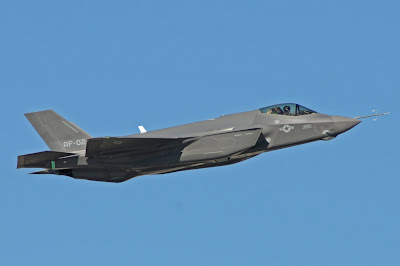
F-35 photo shamelessly ripped off from Outlaw13 ....

Saturday, May 29, 2010

Darth Vader Does NAVAIR

VAQ-209 is a Naval Aviation Reserve Squadron, based at NAF Andrews, near Washington DC. The squadron flies the Grumman EA-6B Prowler, and electronic jamming aircraft. VAQ-209's traditional role is to serve as backup for regular forces. Lately, to meet OIF and OEF requirements, -209 has been a land based deployable squadron.

VAQ-209's nickname is "Starwarriors". For several years, a small outlined Darth Vader head has adorned their tail. For this year, the squadron came up with a spectacularly painted CAG bird. Darth has been spotted in all of his glory!

A couple of shots of 161883, seen at the NAS Ft. Worth open house recently.


For those of you not 'in the know' ... CAG is a Naval Aviation term that dates back to the '30s, and refers to 'Commander, Air Group'. This was the fellow who commanded all of the aircraft deployed on an aircraft carrier. In the '60s, squadrons started paying tribute to their CAG by painting up one squadron aircraft in colorful, non-standard markings, and putting his name on the canopy rail. This aircraft was then known as the 'CAG Bird'.

These days, indeed since WWII, it is known as a Carrier Air Wing, not Carrier Air Group. However, the name CAG has stuck even after all of these years - calling the boss CAW just doesn't sound right, does it?

Sunday, May 23, 2010

Big "E" Rejoins the Fleet

After a two year refit, The USS Enterprise CVN-65 completed flight deck certification trials on May 14 prior to embarking on her 21st cruise. The nation's first nuclear powered carrier, Enterprise has received upgrades and maintenance during her two year absence from the fleet.


CVN-65 will soon set sail with Air Wing 1 (CVW-1) aboard, comprised of VFA-11 (F-18F), VFA-136 (F-18C), VFA-211 (F-18F), VMFA-251 (F-18C), VAW-123 (E-2C), VAQ-137 (EA-6B), VRC-30 Det.2 (C-2A), and HS-11 (SH-60F).
Photos - VFA-211 Super Hornets conducting flight operations during flight deck certification - US Navy photos.

Tuesday, May 18, 2010

A Hero Passes


Col. Walker 'Bud' Mahurin passed away on May 11, at the age of 91.

Col. Mahurin flew P-47 Thunderbolts with the 56th Fighter Group out of England in 1943 and 1944. He was shot down March 27, 1944 over France, but managed to evade and escape back to England. After leave in the US, he was transferred to the Pacific where he flew P-51s.

Bud was credited with 20.75 German and Japanese 'kills' during the war, making him one of the highest ranking US aces.

During Korea, Col. Mahurin flew F-86 Sabres, shooting down 3 MiG-15s. He was shot down on May 13, 1952, and spent 16 months in a North Korean prison suffering intense interrogation and torture.

Col. Mahurin was the only US flyer to shoot down enemy aircraft in both Europe and the Pacific during WWII, and then in Korea. He retired from military service in 1956, and went to work for North American Aviation in SoCal.

Godspeed, Colonel ...

Wednesday, April 21, 2010

EADS Reenters KC-X Competition


EADS (Airbus) has reentered the USAF's KC-X competition. Northrup-Grumman announced its withdrawl from the competition back in February. N-G had been partnered with EADS to offer the KC-30, a militarized tanker version of the A330 airliner. N-G backed out, seeing that the refined requirements set out in the competition gave Boeing's KC-767 a big advantage in the competition. Basically, N-G decided to stop throwing good money after bad, and handed the contract to Boeing.

Well, Airbus has decided to attempt to push the KC-30 by itself, without N-G as a partner. I rate their chance as slightly better than Obama shrinking the Federal government.

N-G's bid included some powerful incentives - assembly of the KC-30 would have been in Alabama, benefiting a large number of US companies and creating a large US workforce to produce the 179 aircraft the contract covers. EADS' bidding on its own would seem to not have that advantage - the aircraft will undoubtedly be built in Airbus' European factories.

Airbus has a very poor record of delivering new design aircraft on time. Their long going A-400M project to build a medium capacity airlifter is so far behind schedule, so far above projected costs, that many of the partner countries have backed out of the project and chosen to buy C-17s and new model C-130s instead.

The KC-X contract is worth at least $35,000,000,000. I understand why EADS would want to try to get it, but I don't understand why they are getting back in when the deck is stacked so far against them. I see this as a waste of money for EADS, and a big embarrassment when their aircraft loses to Boeing again.

Tuesday, April 20, 2010

Mustang Magic

I had heard about this mass gathering of Mustangs a couple of years ago, but had just now stumbled upon some video on Youtube. Decent quality video at that. The occasion was on Sep. 30, 2007, at Rickenbacker Airport in Columbus OH - the Gathering of Mustangs.

There is nothing that sounds like a Merlin powered Mustang. Arguably the best fighter aircraft ever built (given it's time period), it is a magic machine. Easily the most prolific fighting warbird still in existence, it is a treat to see one or two at an airshow. For this meet, 20 (yes TWENTY) of them were in attendence. I truly wish I had been there to see this - a sight that hadn't been seen since the days of WWII - twenty P-51s in formation!

Very cool.


Tuesday, April 13, 2010

NAVAIR - 2 Crashes Claim 4 Lives

A VAW-121 E-2C Hawkeye, BuNo 166508, based on the USS Eisenhower crashed in the Arabian Gulf on a normal mission on March 31. The aircraft lost power on one engine while returning to the carrier from its surveillance mission. The pilot held the aircraft steady while the other 3 crew members bailed out, but was unable to get out himself before the plane impacted the water. He gave his life so the others could get out safely.


A VT-86 T-39N Saberliner training aircraft, BuNo 165513, based at NAS Pensacola, crashed near Atlanta on April 12, killing three on board. The same area was the site of another T-39 crash back in 2006, which killed all 4 on board.


Military aviation is a deadly serious business, even during normal operations.

Wednesday, April 7, 2010

It's a Hawg's Life

The Fairchild Republic A-10 Thunderbotl II was designed in the early '70s to meet a USAF requirement for a tank killing close air support aircraft. It's primary purpose was to defeat the anticipated Soviet tank attack that would come through Germany, should war ever break out.

The A-10 was designed around it's huge 30mm GAU-8 Gatling gun. Firing rounds of depeleted uranium at 2,000 or 4,000 rounds per minute, this awesome weapon was capable of chewing up a tank in short order. 11 weapons hardpoints allow the aircraft to carry a massive amount of varied ordanance.

The A-10 almost immediately gained the nickname 'Warthog' due ito its ungainly appearance. Indeed, few actually refer to the jet as Thunderbolt, most folks just call it 'The Hawg'.


Equipped with twin tails, twin engines, multiple redundant controls, and an armored titanium coccoon around the pilot, the Hawg was designed to take a lot of punishment and get its pilot back home. It is not a fast jet, max speed is about 450mph, but it is highly manueverable, and quiet. Most of its work is done at low level.

Production was 707 airframes, not counting pre-production, buiilt from 1975 to 1982.

With the end of the cold war, many in the Air Force pushed for the retirement of the A-10, saying it was redundant. Some of the earlier airframes started going to the boneyard in the late '80s. It's reprieve came in the form of Desert Storm.


DS operations showed that the A-10 was far from obsolete. It destroyed hundreds of Iraqi tanks and vehicles. 18 A-10s were hit by enemy fire, 4 of which were downed. 2 more A-10s were lost in landing accidents. More than 1 A-10 brought its pilot home after taking significant damage.

The post DS force drawdown initiated by Clinton saw the A-10 active duty force hit hard, with several wings being deactivated. The A-10, however, continued to prove its worth over Bosnia. It has been a critical component of the Global War on Terror, and its presence over Iraq and Afghanistan has been constant since our forces liberated those countries.


Today, about half of the A-10s built are still flying. The majority have been through multiple upgrades and service life extensions that will keep them active for at least another 15 years. While the F-22 and F-35 are set to replace the F-15 and F-16, there is no replacement on the boards for the A-10.


Once the stepchild of the pointy-end fighter Air Force, the 'Hawg continues to prove its worth, and will outlive the jets that came after it - the very ones that were supposed to have made it obsolete.


Lone Star Flight Museum's P-47D Thunderbolt "Tarheel Hal' sitting besides its namesake, A-10A Thunderbolt II 79-0147, 47FS 917WG, at the Hawg's home base of Barksdale AFB. Photo by yours truly.


Friday, April 2, 2010

'Vark Dump and Burn, Aussie Style

The F-111 Aardvark was operated only by two forces - the USAF and the Australians. The aircraft has never received its due, in my opinion. A friend, Quizmo, flew these incredible aircraft out of Lakenheath and Cannon, before moving on to Beagles.

The F-111 served in A, C, D, E, F, G, EF- and FB- versions. A Navy version, the B, was initially developed, but was found to be totally unsuitable for carrier operations. Sadly, the last American Aardvarks were retired back in the mid-1990s, but the Australians still fly them.

The F-111 has a fuel dump nozzle uniquely placed - between the two engine exhausts. If the dump was turned on while the jet was in afterburner, a 100 foot long torch shot out the rear of the aircraft. The USAF deemed this to be too dangerous to allow, but the Aussies jumped on it and used it to great delight at airshows and other events.

Here are a couple of Aussie 'torches' for your enjoyment ....


Romania Chooses F-16 Over F-35

Romania has signed a deal to purchase 48 F-16 fighters from the US. 24 of the aircraft will be new build Block 50s, to be delivered by 2020. The remaining 24 will be refurbished Block 25s, recently retired from US use and now sitting in the boneyard in Tucson. The deal is said to be worth $4.5 billion, including spares and training. This will give Romania two squadrons of capable fighter bombers, compatible with NATO standards.

The order was chosen over an offer for 24 F-35s at a cost of over $6 billion (at current aircraft cost, which is very likely to go higher), none of which would be delivered before 2020.

One has to wonder - if the F-16 is still so potent a weapon that it is first choice for foreign orders, why is the USAF retiring so many of them prematurely?