Some gratuitous Tomcat footage ....
I do miss seeeing this bad ass bird!!
Saturday, July 17, 2010
Thursday, July 15, 2010
Three American Heroes
Vernon Baker passed away at his home this past Tuesday in Idaho, at the age of 90. Lt. Baker received the Medal of Honor for actions against the Germans on an Italian hilltop on April 5, 1945. He was cited for wiping out four machine gun nests while leading his platoon through a maze of bunkers and gun emplacements. He was assigned to the 92nd Infantry Division.
Lt. Baker received his Medal of Honor on Jan. 13, 1997 from President Clinton at the White House, in a ceremony that honored 7 soldiers with the Medal of Honor long after their displays of heroism. All 7 were black. Lt. Baker was the only one who was still alive at the time of the ceemony.
Godspeed, Lt. Baker ....

Army Specialist Jerrod Osborne, a resident of Rockwall TX, was an Army medic serving in Afghanistan. He was awarded the Bronze Star for actions this past May for saving lives in the aftermath of a IED explosion. He was later awarded the Purple Heart. He served with the 82nd Airborne.
Jerrod Osborne, age 20, died in another IED explosion in Afghanistan on July 5.
Thank you, Spc. Osborne, for your service and sacrifice for our country ...

Staff Sergeant Zackary Filip, of Denton TX (the town where I grew up), has been named the Army Times' Soldier of the Year for 2010. The medic has served in Afghanistan. He was at the Ft. Hood Readiness Center this past November when an Islamic terrorist attacked. He is credited with saving the life of the civilian police officer who shot the terrorist, and for treating multiple other victims of the attack.
Thank you SSgt. Filip , for your service to our country...

Wednesday, July 14, 2010
Obama Wants To Cut Nuke Arsenal By 40%
A Department of Energy document, presented to Congress in May but just now being let out to the public, details that Obama wants to cut the US nuclear arsenal by 40% by the year 2021.
Obama's Secretary of State Clinton back in May announced to the world that we currently had 5113 warheads in our stockpile. What exactly they wanted to accomplish by giving this information to our enemies is not clear.
Now, they've detailed that they want to cut our forces to around 3,000 warheads. This is unilateral disarmement - no one else in the world is going to cut their nuclear forces, including the Soviets and Chinese - the very countries Obama is trying to suck up to.
Unbelievable stupidity. If you want to cut the nukes, fine. But why tell all of our enemies exactly what we have and what we are doing? It's simple - Obama wants all of our enemies to be his friends, and he thinks that by appearing to be weak and appeasing they will love him as he loves himself. All they are really doing is laughing their asses off at his stupidity.
Obama's Secretary of State Clinton back in May announced to the world that we currently had 5113 warheads in our stockpile. What exactly they wanted to accomplish by giving this information to our enemies is not clear.
Now, they've detailed that they want to cut our forces to around 3,000 warheads. This is unilateral disarmement - no one else in the world is going to cut their nuclear forces, including the Soviets and Chinese - the very countries Obama is trying to suck up to.
Unbelievable stupidity. If you want to cut the nukes, fine. But why tell all of our enemies exactly what we have and what we are doing? It's simple - Obama wants all of our enemies to be his friends, and he thinks that by appearing to be weak and appeasing they will love him as he loves himself. All they are really doing is laughing their asses off at his stupidity.
Thursday, July 8, 2010
Where Have All The Tomcats Gone? Part III
The Tomcat served with four US Navy Reserve squadrons, two located at NAS Miramar and two at NAS Dallas. The two Miramar squadrons were disestablished on December 31, 1994, and one of the Dallas squadrons on October 1, 1994 - all because of budget cuts. The final Reserve squadron lasted until 2006, when it too fell to the budget axe.
The Tomcat saw some limited service as an adversary platform with Top Gun at Miramar and NSAWC at Fallon. F-14s were assigned to test organizations for the entire length of its service life. Indeed, the very last Tomcat built served exclusively with a test squadron from its acceptance until its retirement - never once landing on a carrier deck!
During its service in the US Navy, Tomcats equipped 24 Fleet squadrons (12 Air Wings), 4 Reserve Squadrons (2 Air Wings), 2 training squadrons, and 10 test/development organizations.

VF-201 received its first F-14 in January of 1987. It received very old Tomcats, which had been rebuilt by Grumman to new standards. They also got 2 of the last 4 F-14As off the production line. After the closure of NAS Dallas in 1996, the squadron moved to the new NAS Ft. Worth (ex-Carswell AFB). The Hunters gave up their Tomcats and became VFA-201 in 1998, flying F-18A Hornets. The squadron was finally disestablished in 2006 as a result of budget cuts. 160396, seen here on the Ft. Worth flightline in 1998, was the last Hunters CAG F-14. This jet survived its service with -201 and was retired to AMARC as 1K0118.

The very last F-14A built, BuNo 162711, was delivered to reserve squadron VF-202 at NAS Dallas directly from the Grumman factory in 1987. In a strange twist, VF-201 and VF-202 ended up flying the very oldest Tomcats in the inventory (albeit they had been rebuilt to new standards) and the very last F-14As produced - a very odd combination. 162711 had a surprisingly short career for such a young airframe. It last served with VF-101, and was reportedly delivered to NAS Jacksonville FL in a wrecked condition in 1998 - where it was to be dumped into the sea as an artificial reef.

VF-301 was one of two F-14 squadrons assigned to Reserve Carrier Air Wing 30, the West Coast NAVAIR reserve Air Wing. They were based at Miramar, where BuNo 158990 is seen in this photo. The Devil's Disciples were disestablished on December 31, 1994, when budget cuts eliminated Air Wing 30. 158990 was one of the first Tomcats retired from fleet service, going to AMARC on August 26, 1991, with inventory number 1K0039.

VF-302's Stallions were based at Miramar along with its sister squadron VF-301. Operating some of the oldest Tomcats in the fleet, the Stallions provided reservists with Tomcat training and flight time. BuNo 159591 is seen here waiting for takeoff at Bergstrom AFB during the RAM 88 Recon competition. -302's jets participating in the meet carried the TARPS (Tactical Air Recon Pod System) for film and other visual sensor data capture. VF-302 shut down on December 31, 1994, along with the rest of Reserve Carrier Air Wing 30. 159591 finished its flying career with VF-101, and was written off in April of 2001.

The Naval Air Test Center (NATC) at NAS Pax River made use of multiple F-14s over the life of the Tomcat program, to test systems and upgrades. Initially they carried the tail code 7T, which was the station code for Pax River. Later, when NATC was redesignated Strike Directorate, the tail code changed to SD. BuNo 158620, a very early production jet, is seen here passing through Dallas in 1985. In less than 2 years, it would be rebuilt by Grumman to newbuild standards, and be delivered to VF-202 at this very base.

Top Gun, the Navy's Fighter Weapons School at Miramar, made use of a few Tomcats for adversary training. This great looking bird is BuNo 159855, see at Miramar in December of 1991. It is painted to simulate a Russian SU-27. When Top Gun was reformed as the NSAWC and moved to NAS Fallon, a few Tomcats continued to serve in the role. However, its time as a bad guy was short - high operating costs and high maintenance requirements ended up getting it replaced with early production F-18 Hornets rather quickly.

BuNo 164604 was the last F-14 built, being delivered to NAS Pt. Mugu from Grumman in 1992. Nicknamed 'Vandy One', this jet carried the overall black scheme for most of its career. It served with VX-4, and then VX-9, fleet test squadrons, at Pt. Mugu for its entire career. The jet is seen here attending an airshow in Oklahoma City in 1998. Upon retirement, this aircraft was delivered to NAS Oceana, to become a monument to the F-14. Unfortunately, someone decided to paint it in the same grey as fleet aircraft, instead of leaving it in this special paint scheme.
All Photos by yours truly.
The Tomcat saw some limited service as an adversary platform with Top Gun at Miramar and NSAWC at Fallon. F-14s were assigned to test organizations for the entire length of its service life. Indeed, the very last Tomcat built served exclusively with a test squadron from its acceptance until its retirement - never once landing on a carrier deck!
During its service in the US Navy, Tomcats equipped 24 Fleet squadrons (12 Air Wings), 4 Reserve Squadrons (2 Air Wings), 2 training squadrons, and 10 test/development organizations.
VF-201 received its first F-14 in January of 1987. It received very old Tomcats, which had been rebuilt by Grumman to new standards. They also got 2 of the last 4 F-14As off the production line. After the closure of NAS Dallas in 1996, the squadron moved to the new NAS Ft. Worth (ex-Carswell AFB). The Hunters gave up their Tomcats and became VFA-201 in 1998, flying F-18A Hornets. The squadron was finally disestablished in 2006 as a result of budget cuts. 160396, seen here on the Ft. Worth flightline in 1998, was the last Hunters CAG F-14. This jet survived its service with -201 and was retired to AMARC as 1K0118.
The very last F-14A built, BuNo 162711, was delivered to reserve squadron VF-202 at NAS Dallas directly from the Grumman factory in 1987. In a strange twist, VF-201 and VF-202 ended up flying the very oldest Tomcats in the inventory (albeit they had been rebuilt to new standards) and the very last F-14As produced - a very odd combination. 162711 had a surprisingly short career for such a young airframe. It last served with VF-101, and was reportedly delivered to NAS Jacksonville FL in a wrecked condition in 1998 - where it was to be dumped into the sea as an artificial reef.
VF-301 was one of two F-14 squadrons assigned to Reserve Carrier Air Wing 30, the West Coast NAVAIR reserve Air Wing. They were based at Miramar, where BuNo 158990 is seen in this photo. The Devil's Disciples were disestablished on December 31, 1994, when budget cuts eliminated Air Wing 30. 158990 was one of the first Tomcats retired from fleet service, going to AMARC on August 26, 1991, with inventory number 1K0039.
VF-302's Stallions were based at Miramar along with its sister squadron VF-301. Operating some of the oldest Tomcats in the fleet, the Stallions provided reservists with Tomcat training and flight time. BuNo 159591 is seen here waiting for takeoff at Bergstrom AFB during the RAM 88 Recon competition. -302's jets participating in the meet carried the TARPS (Tactical Air Recon Pod System) for film and other visual sensor data capture. VF-302 shut down on December 31, 1994, along with the rest of Reserve Carrier Air Wing 30. 159591 finished its flying career with VF-101, and was written off in April of 2001.
The Naval Air Test Center (NATC) at NAS Pax River made use of multiple F-14s over the life of the Tomcat program, to test systems and upgrades. Initially they carried the tail code 7T, which was the station code for Pax River. Later, when NATC was redesignated Strike Directorate, the tail code changed to SD. BuNo 158620, a very early production jet, is seen here passing through Dallas in 1985. In less than 2 years, it would be rebuilt by Grumman to newbuild standards, and be delivered to VF-202 at this very base.
Top Gun, the Navy's Fighter Weapons School at Miramar, made use of a few Tomcats for adversary training. This great looking bird is BuNo 159855, see at Miramar in December of 1991. It is painted to simulate a Russian SU-27. When Top Gun was reformed as the NSAWC and moved to NAS Fallon, a few Tomcats continued to serve in the role. However, its time as a bad guy was short - high operating costs and high maintenance requirements ended up getting it replaced with early production F-18 Hornets rather quickly.
BuNo 164604 was the last F-14 built, being delivered to NAS Pt. Mugu from Grumman in 1992. Nicknamed 'Vandy One', this jet carried the overall black scheme for most of its career. It served with VX-4, and then VX-9, fleet test squadrons, at Pt. Mugu for its entire career. The jet is seen here attending an airshow in Oklahoma City in 1998. Upon retirement, this aircraft was delivered to NAS Oceana, to become a monument to the F-14. Unfortunately, someone decided to paint it in the same grey as fleet aircraft, instead of leaving it in this special paint scheme.
All Photos by yours truly.
Wednesday, July 7, 2010
Where Have All The Tomcats Gone? Part II
Atlantic Fleet Tomcats were based at NAS Oceana, VA. For most of their career, the Tomcats shared the huge base with the A-6 Intruders of the Atlantic Fleet.
When the Tomcat's career started winding down, NAS Miramar in San Diego was transferred to Marine control, and the remaining Tomcat squadrons were sent to Oceana. So, for a time, both Atlantic and Pacific fleet Tomcats were based out of one location. (For purposes of this posting, only the Atlantic Fleet squadrons will be covered.)
When the Tomcat's career started winding down, NAS Miramar in San Diego was transferred to Marine control, and the remaining Tomcat squadrons were sent to Oceana. So, for a time, both Atlantic and Pacific fleet Tomcats were based out of one location. (For purposes of this posting, only the Atlantic Fleet squadrons will be covered.)

F-14B 163227 was VF-11's CAG bird during the squadron's last days as a Tomcat squadron, seen here at the Alliance Airport TX airshow in October of 2004. Renamed, VFA-11 is now flying Super Hornets out of Oceana. 163227 survived its service, and retired to AMARC under the inventory number 1K0188.
The Top Hatters of VF-14 owned this jet, 159023, when it was seen on a cross country flight in 1986. The scuzzy grey paint scheme was typical of how typical fleet Tomcats looked - not very pretty to look at, but effective in helping disguise the aircraft in an air combat environment. This particular aircraft finished its flying days with the NATC at Pax River, and was stricken from the inventory on April 2, 1992.
VF-31's 161862, seen here at an airshow at Carswell AFB in 1990. This throwback paint scheme honored the markings carried by the squadron when it first got F-14s. The red tails, black noses, and Felix the Cat running with a bomb were spectacular. VF-31 was the last US Navy squadron to operate the Tomcat, relenquishing their D models in 2006. This aircraft was converted to B model standards, survived its service, and was retired to AMARC as 1K0182.
VF-32 was known as the Swordsmen. F-14A BuNo 162694, the squadron's CAG bird, is seen here at Dallas in 1988 on approach to RW17. It was later modified into a F-14B. It was written off on October 3, 2002, while serving with VF-101. VF-32 has become VFA-32, and now flies the F-18F Super Hornet at Oceana.
VF-33 was known as both the Tarsiers and the Starfighters, depending upon who and when you asked. BuNo 159427, an early production A model, is seen here at Oceana during 1986. The aircraft survived its service to become the 43rd Tomcat retired to AMARC, delivered there in 1991. It was scrapped in 1994.
VF-41 Black Aces F-14A 160381 taking off from RW35 one morning at NAS Dallas in 1987. 160381 crashed on August 26, 1994, while flying with VF-84. It suffered an inflight engine fire and went down off of the NC coast - both crew members were safely recovered. 
The VF-74 Bedevilers flew both the A and B models of the F-14. F-14B 162922 is seen during a Dallas refueling stop during 1989. VF-74 was disestablished on April 30, 1994. 162922 finished its flying days with VF-32, and was retired to AMARC as 1K0164.
My favorite Tomcat squadron markings of all time - the VF-84 Jolly Rogers. Nothing quite epitomized the Tomcat like the Skull and Crossbones on a black tail - pirate stuff to be sure. BuNo 162702 is seen here on the NAS Dallas transient ramp during a November 4, 1989 stopover. The jet crashed shortly after this photo was taken, on June 5, 1990. VF-84 was disestablished on October 1, 1995. VF-103 took the lineage of the Skull and Crossbones (see below), but it just wasn't the same!
F-14D 164342 of VF-101, seen at an airshow at Alliance Airport, TX during October of 2004. This was one of the Tomcat's last airshow appearances. The aircraft carried sharp tail markings and a mean looking sharkmouth as it approached retirement. When VF-101 shut its doors, the jet transferred to VF-31, and was part of that squadron until the very end of US Navy Tomcat operations. It is now preserved at the Wings over Miami museum. VF-101 was the Atlantic coast training squadron, keeping a roster of up to 40 F-14s on the Oceana ramp to support training requirements.
VF-102's CAG bird landing on RW 17 at NAS Dallas. This Diamondbacks' jet was transiting through the base between cruises in 1987. BuNo 162695 was a combat veteran of the First Gulf War, and survived its service to retire to AMARC as 1K0171. VF-102 became VFA-102, and now flies the F-18F Super Hornet.
VF-103's 160390 seen landing on RW 17 at NAS Dallas in 1988. -103 had a confusing career in the F-14. First known as the Sluggers, it went through three different types of tail markings (the first of which, an arrow, is illustrated here). When VF-84 was disestablished, VF-103 then took the Jolly Rogers name and heritage, and started using the VF-84 tail markings. The Navy's explanation was that they wanted to keep the long lineage of the Jolly Rogers going - but that didn't make a lot of sense. If the lineage was that important, why didn't they get rid of -103 and keep -84? I don't know ... 160390 was one of the most famous/infamous Tomcats. While flying with VF-41, it downed a Libyan SU-22 on August 19, 1981. Later, while with VF-213, it crashed while approaching the USS Lincoln on October 25, 1994. The crash claimed the life of Lt. Kara Hultgreen, one of the first two female Naval Aviators assigned to a fleet squadron.
VF-142 Ghost Riders flew the F-14A until they were disestablished on April 30, 1995. -142 was always paired with -143 during carrier deployments. BuNo 161427 is seen here on the Oceana ramp during 1986. This aircraft was lost on July 30, 1998, while flying with VF-103.
VF-143 is known as the Pukin Dogs, a backhanded compliment for the squadron's insignia, which is supposed to be a griffon - but actually looks like a dog throwing up. The Dogs were one of the last F-14 squadrons in service receiving F-18E Super Hornets after retiring their Tomcats to AMARC. AG-114, BuNo 162924, was a B model assigned to the squadron when this photo was taken of it arriving transient at Carswell AFB in 2001. The squadron had just come back from a deployment aboard the USS JFK. This aircraft was struck from the inventory on Sep. 15, 2004.
All Photos by yours truly.
Tuesday, July 6, 2010
Where Have All The Tomcats Gone? Part I
The F-14 Tomcat was retired from US Navy service back in 2006, after 34 years of defending the fleet. An elegant fighter that was nicknamed 'Turkey', the Tomcat was a loud, impressive aircraft that was designed as a fleet defense fighter, and morphed into a capable attack platform late in its career. Age and politics got to the F-14 in the end, with the F-18 Hornet taking its place on the Navy's carrier decks.
I had the pleasure of photographing several hundred of the 700+ F-14s that were built. For no particular reason, I'd like to share some of those photos here. I do miss that aircraft. I'll put these into three postings: Tomcats of the Pacific Fleet (PACFLT), Tomcats of the Atlantic Fleet (ATLFLT), and Rerserve/Adversary/Test Units.
First, F-14s of the Pacific Fleet. PACFLT Tomcats were based at NAS Miramar, outside of San Diego. Known as Fightertown, Miramar's ramp featured dozens of F-14s from their introduction to the fleet in 1972, through the base being turned over to the Marine Corps in October of 1997.
I had the pleasure of photographing several hundred of the 700+ F-14s that were built. For no particular reason, I'd like to share some of those photos here. I do miss that aircraft. I'll put these into three postings: Tomcats of the Pacific Fleet (PACFLT), Tomcats of the Atlantic Fleet (ATLFLT), and Rerserve/Adversary/Test Units.
First, F-14s of the Pacific Fleet. PACFLT Tomcats were based at NAS Miramar, outside of San Diego. Known as Fightertown, Miramar's ramp featured dozens of F-14s from their introduction to the fleet in 1972, through the base being turned over to the Marine Corps in October of 1997.

The Wolfpack of VF-1 was established in 1972 as one of the first two F-14 fleet squadrons. They sailed on the USS Enterprise, and actually were in SEA at the conclusion of the Vietnam War, though they did not fly combat missions. 162597 is seen carrying throwback CAG markings at Miramar in 1988, duplicating the markings all of its jets carried when the squadron first stood up. VF-1 was an early victim of Clinton's massive military drawdown after the First Gulf War, standing down on October 1, 1993. 162597 was struck from the inventory on Feb. 18, 1999 after finishing its service life with VF-14.
VF-2 was the Wolfpack's sister squadron during the early days of the Tomcat, participating on that first cruise. Also carrying throwback markings, 162596 on Miramar's ramp in 1988. Now known as VFA-2, ths unit currently flies the F-18F Super Hornet. This aircraft crashed on Sep. 22, 1988, less than 6 months after this photo was taken.
Many of VF-21's F-14As carried this attractive yellow and black scheme when they were delivered from the Grumman factory. The glossy grey paint was applied by Grumman to all F-14As when delivered as new, as stated by contract. Low-vis tactical grey paint was applied to all F-14B and D aircraft delivered. 161615, NK-205, seen here at Miramar in 1988, between cruises on the USS Constellation. The Freelancers were disestablished on January 31, 1996.
This VF-24 F-14B was caught transiting through NAS Dallas in 1989. BuNo 163224, normally based at Miramar, coded NG-203. The Fighting Renegades were disestablished on August 31, 1996, one of the last victims of the Clinton cuts. This aircraft survived to be retired to AMARC as 1K0148.
The Screaming Eagles of VF-51 carried this attractively painted CAG bird in 1991. NL-100 was BuNo 162602. VF-51 was disetablished along with its stablemate VF-111 on March 31, 1995. 162602 crashed while flying with VF-51 on July 11, 1994. 
VF-111's Sundowners teamed with VF-51 on carrier cruises. The sharkmouth and sunburst on the tail were some of the most striking markings carried by any Tomcat. The CAG bird, 162594, heads a line of normal grey squadron aircraft on the Miramar ramp in 1991. VF-111 stood down on March 31, 1995. Recently, VFC-111 was established at NAS Key West, flying F-5s in an aggressor role. This aircraft crashed while flying with VF-101 out of Oceana on Oct. 3, 2002.
The Aardvarks of VF-114 flew off the Enterprise for most of their time in the Tomcat. 161615, NH-107, seen in the afternoon sun at Miramar in 1991. The 'Varks were one of the first squadrons lost during the Clinton cutbacks, being disestablished at Miramar on April 30, 1993. 161615 is preserved at the Combat Air Museum, Forbes Field, KS.
VF-124 was the West Coast F-14 training squadron, tasked with readying pilots and RIOs to operate the F-14 for Pacific Fleet Squadrons. Based at Miramar, the squadron was not assigned to an Air Wing. Gunfighter 400, BuNo 161620, seen here at Miramar in 1991, carried special markings as the CAG bird. The unit's other aircraft weren't nearly as colorful! VF-124 was disestablished on September 30, 1994 - at that point all F-14 training was transferred to VF-101 at Oceana. 161620 survived its service, and is preserved at the air museum at Selfridge ANGB near Detroit.
VF-154's Black Knight 102, BuNo 161614, seen at its home base of Miramar in 1988. -154 later forward deployed to NAF Atsugi (Japan), becoming the only Tomcat squadron based on foreign soil. VFA-154 survived the drawdowns and now flies the F-18F.
VF-191 was one of the shortest lived F-14 squadrons, being established in 1987 to join the new Air Group CVW-10. CVW-10 was scrapped before it ever deployed to a carrier, due to budget cuts. 161279, NM-102, see here on a approach to NAS Dallas in February of 1988. The squadron stood down on April 30, 1988. This aircraft was last used by VF-101 at Oceana, and struck from the inventory on Dec. 12, 2003.
VF-194 was -191's stablemate in CVW-10. Satan's Kittens' CAG bird is seen on the MIramar ramp in March of 1988, shortly before the squadron stood down on April 30, 1988. This aircraft, BuNo 161626, survived its service and retired to AMARC as 1K0160.
F-14B 163229, VF-211's NG-100. Normally based at Miramar, seen here on the NAS Dallas TLine in 1989. When Miramar moved to Marine hands, VF-211 moved to NAS Oceana along with the rest of the Pacific F-14s. Upon retirement of its F-14s, -211 stood down for a time, then was reborn with F-18Fs. The unit currently flies off the USS Enterprise. 163229 was retired to AMARC with the inventory number 1K0172.
VF-213's 160920, NH-213, seen transiting through NAS Dallas in 1985. VF-213 moved to NAS Oceana when Miramar reverted to Marine hands. The Black Lions were one of the last squadrons to fly the F-14, giving up their F-14Ds for F-18Fs. This specific aircraft was retired by 1999, and transferred to a 'museum' at Chino CA, where it became embroiled in a controversy regarding Tomcat parts being delivered to Iran.
All Photos by yours truly.
Thursday, June 24, 2010
T-38 Talon - Replacement Finally On The Horizon?

The T-38 has been the USAF's advanced pilot training aircraft since the late '50s. Generations of military pilots have trained in these aircraft. My father, who left the USAF in 1965, learned the figher pilot trade in and later instructed in the T-38.
Most of the 450 or so T-38s remaining in service have just gone through a major update/upgrade, and are now referred to as T-38C. T-38s were manufactured by Northrup from 1959 to 1970. The majority of those still flying were built in 1966, 67, and 68, making the average age of a front line T-38 about 45 years old.
 T-38A 68-8139, 7FS 49FW, based and photographed at Holloman AFB. These black jets were used for pilot proficiency and chase plane duties when the 49th was equipped with the F-117A Stealth Fighter.
The T-38C update will keep these aircraft in the air for another decade, if necessary.
The USAF has started the replacement process, finally. In a few months, a contest will be announced for designs and bids to produce the esimated 350 training aircraft deemed necessary to replace the T-38. The winning aircraft could garner as many as 1000 ordered, depending upon foreign customers and possible variations of the basic aircraft (such as a light strike platform).
The competitors appear to be:
Northrup - which is anticipated to offer a further upgrade/life extension program for the existing T-38 airframes.
Korean Air Industries/Lockheed-Martin - this partnership produced the Korean produced T-50 trainer, currently only in use by the South Korean Air Force.
Alenia Aermacchi - expected to offer a derivative of their M-346 trainer, currently in use by the Italian Air Force and others as both a trainer and light strike aircraft.
BAE Systems - which will offer a version of their Hawk training/light strike aircraft, used in the UK, US (Navy), and multiple Air Forces around the world.
Boeing - which is being very quiet about what it will offer, but is thought to be a new design purpose built for the application.
It is expected that some of these companies may team up to push an offering, with Alenia (Italy) and BAE (UK) seeking a US partner, either Northrup or Boeing. A cooperative effort would be stronger in many aspects.
Northrup has experience, in that they are the designers. makers, and maintainers of the current T-38 fleet. The last complete aircraft they produced, however, was the B-2 - very different technology and requirements, and production wrapped up over 15 years ago.
Alenia has worldwide experience with their MB platform, but very limited US experience - and that experience has been with the very limited use of the C-27 medium transport aircraft by the USAF. They would have to be considered an outsider.
BAE has a strong hand. The Hawk platform has dozens of customers worldwide, the most important of which (for this situation) the US Navy, which operates close to 300 of them. These aircraft, called T-45, were built in the US, and are highly modified examples of the main design. The mods were necessary to make the aircraft suitable for use on aircraft carriers. If BAE is chosen, the aircraft would likely be built through their partnership with Boeing, the same way the T-45 was produced.
Boeing, by itself, would have a hard time pushing a brand new aircraft to fill the need. With the spiralling costs and mismanagement seen in the F-22 and F-35 programs, Congress is not going to be in the mood to purchase billions of dollars worth of new, unproven designs when existing aircraft can be used with minimal program risk.
KAI/L-M's big advantage is that Lockheed is the manufacturer of the only two fighter aircraft that will be left in the inventory by the time the new trainer reaches operational capability - the F-22 and the F-35. L-M's familiarity with those aircraft would allow them to claim the knowledge necessary to build a trainer that would lead into the -22 and -35 seamlessly. There is a big drawback in that approach; since L-M has so much of the USAF's business, the Air Force and Congress may decide that the new contract needs to go to someone else.
No matter what design is chosen for the future requirement, it is certain that we will continue to see this sleek little jet flying around for many years to come.
 T-38A 70-1955, assigned to the 81FTW, based at Williams AFB. Seen landing at NAS Dallas in 1988. This was the second to last T-38 built.
T-38C 64-13225 of the 25FTS, 71FTW, leads other T-38s from the 90FTS, 80FTW (EN) and 50FTS, 14FTW (CB) on the ramp during 2009.
All photos by your truly.
Thursday, June 17, 2010
USAF Initiates Drone Pilot Training Track

Finally recognizing that using fully trained aircraft pilots to sit in comfy chairs to remotely pilot drones was not the best decision, the USAF has settled on training 'unmanned aerial system' operators specifically to do that mission.
Taking fully qualified pilots to do this job was bad for multiple reasons, but the two biggest were cost (it costs over a million dollars to train an actual pilot), and morale problems (taking a real pilot and dropping him into a trailer to run a flying lawnmower through a video screen was a real hit to the ego, and a career ender).
Five test classes were put through training beginning in 2009, to establish and fine tune the curriculum. Graduates of the first class are now 'flying' operational missions. The second class just graduated, and will soon become operational.
The USAF has a stated need of 1100 drone pilots and operations officers by 2012. Establishing this as a seperate career path from pilot training is smart - saves money, and helps calm down the morale problems.
It will be interesting to me to see if the graduates of this new career path are awarded wings, and if they'll wear flight suits to work.
Wednesday, June 2, 2010
F-35 Costs Spiralling Out of Control
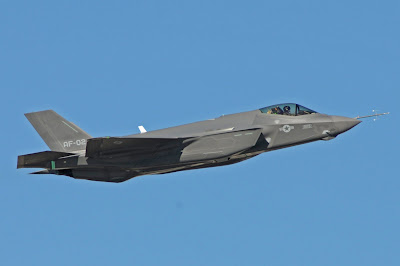
The latest cost projections from independent Pentagon analyists are placing the cost of the F-35 program, for the current number of airplanes projected, at $382 Billion.
This is 65% higher than the original cost projection of $232 Billion, posted in 2002.
The production cost per plane has risen to $92.4 Million, 85% higher than the original projection of $50 Million.
The total cost per plane, including R&D charges, is sitting at $112.4 Million, 81% higher than the original projection of $62 Million.
This is the incredible danger of our government signing 'cost plus' procurement contracts - contracts which guarantee the contractor(s) a percentage of profit no matter what the cost turns out to be. Such contracts give no incentive for the contractor to hold down costs - anything they can push into the program and bill for, they will.
I guarantee that if the US government had signed a fixed cost contract with Lockheed-Martin for the F-35, it would have come in at projected costs. Companies have a way of figuring out how to keep programs on track and on budget when their bottom line depends on it.
The new estimate of $382 follows by two months an estimate released by the F-35 program office in the Pentagon of $328 Billion.
The Congressional Budget Office released a report on May 28 suggesting that the Navy scale back on its planned purchase of F-35C carrier based variants, reducing its order by 93 aircraft. The resulting savings could be spent procurring an additonal 126 F-18 Super Hornets. The Super Hornet is a known design in service, orders could be placed and production started now. A difference of 33 aircraft may not sound like much, but that is the equivalent of 3 full strength Navy Fighter Squadrons. With the dire straits the Navy's legacy Hornet (F-18A/B/C/D) fleet finds itself in, additional Super Hornets could help bridge the Navy's fighter gap - a gap which has lengthened, since the Navy has pushed projected IOC for the F-35C from 2014 back to 2016.
A bad result from a cut in F-35C production is that it will drive the per plane cost up for everyone else, potentially causing even more production cuts.
The percentage of increase will automatically bring the program up for review by Congress, under the Nunn-McCurdy law. That stipulates that any project which exceeds its original budget numbers by more than 50% must be represented to Congress to justify the expense. Congress may take no action, but the law gives it the right to cancel the program outright.
The F-35 is rapidly becomming another F-22. It will be procured in far fewer numbers than were planned, due to the tremendous cost overruns. This will result in a much less combat effective force, and a fighter gap that we will not be able to overcome.
F-35 photo shamelessly ripped off from Outlaw13 ....
Saturday, May 29, 2010
Darth Vader Does NAVAIR

VAQ-209 is a Naval Aviation Reserve Squadron, based at NAF Andrews, near Washington DC. The squadron flies the Grumman EA-6B Prowler, and electronic jamming aircraft. VAQ-209's traditional role is to serve as backup for regular forces. Lately, to meet OIF and OEF requirements, -209 has been a land based deployable squadron.
VAQ-209's nickname is "Starwarriors". For several years, a small outlined Darth Vader head has adorned their tail. For this year, the squadron came up with a spectacularly painted CAG bird. Darth has been spotted in all of his glory!
A couple of shots of 161883, seen at the NAS Ft. Worth open house recently.

For those of you not 'in the know' ... CAG is a Naval Aviation term that dates back to the '30s, and refers to 'Commander, Air Group'. This was the fellow who commanded all of the aircraft deployed on an aircraft carrier. In the '60s, squadrons started paying tribute to their CAG by painting up one squadron aircraft in colorful, non-standard markings, and putting his name on the canopy rail. This aircraft was then known as the 'CAG Bird'.
These days, indeed since WWII, it is known as a Carrier Air Wing, not Carrier Air Group. However, the name CAG has stuck even after all of these years - calling the boss CAW just doesn't sound right, does it?
Sunday, May 23, 2010
Big "E" Rejoins the Fleet

After a two year refit, The USS Enterprise CVN-65 completed flight deck certification trials on May 14 prior to embarking on her 21st cruise. The nation's first nuclear powered carrier, Enterprise has received upgrades and maintenance during her two year absence from the fleet.

CVN-65 will soon set sail with Air Wing 1 (CVW-1) aboard, comprised of VFA-11 (F-18F), VFA-136 (F-18C), VFA-211 (F-18F), VMFA-251 (F-18C), VAW-123 (E-2C), VAQ-137 (EA-6B), VRC-30 Det.2 (C-2A), and HS-11 (SH-60F).
Photos - VFA-211 Super Hornets conducting flight operations during flight deck certification - US Navy photos.
Tuesday, May 18, 2010
A Hero Passes

Col. Walker 'Bud' Mahurin passed away on May 11, at the age of 91.
Col. Mahurin flew P-47 Thunderbolts with the 56th Fighter Group out of England in 1943 and 1944. He was shot down March 27, 1944 over France, but managed to evade and escape back to England. After leave in the US, he was transferred to the Pacific where he flew P-51s.
Bud was credited with 20.75 German and Japanese 'kills' during the war, making him one of the highest ranking US aces.
During Korea, Col. Mahurin flew F-86 Sabres, shooting down 3 MiG-15s. He was shot down on May 13, 1952, and spent 16 months in a North Korean prison suffering intense interrogation and torture.
Col. Mahurin was the only US flyer to shoot down enemy aircraft in both Europe and the Pacific during WWII, and then in Korea. He retired from military service in 1956, and went to work for North American Aviation in SoCal.
Godspeed, Colonel ...
Subscribe to:
Posts (Atom)

